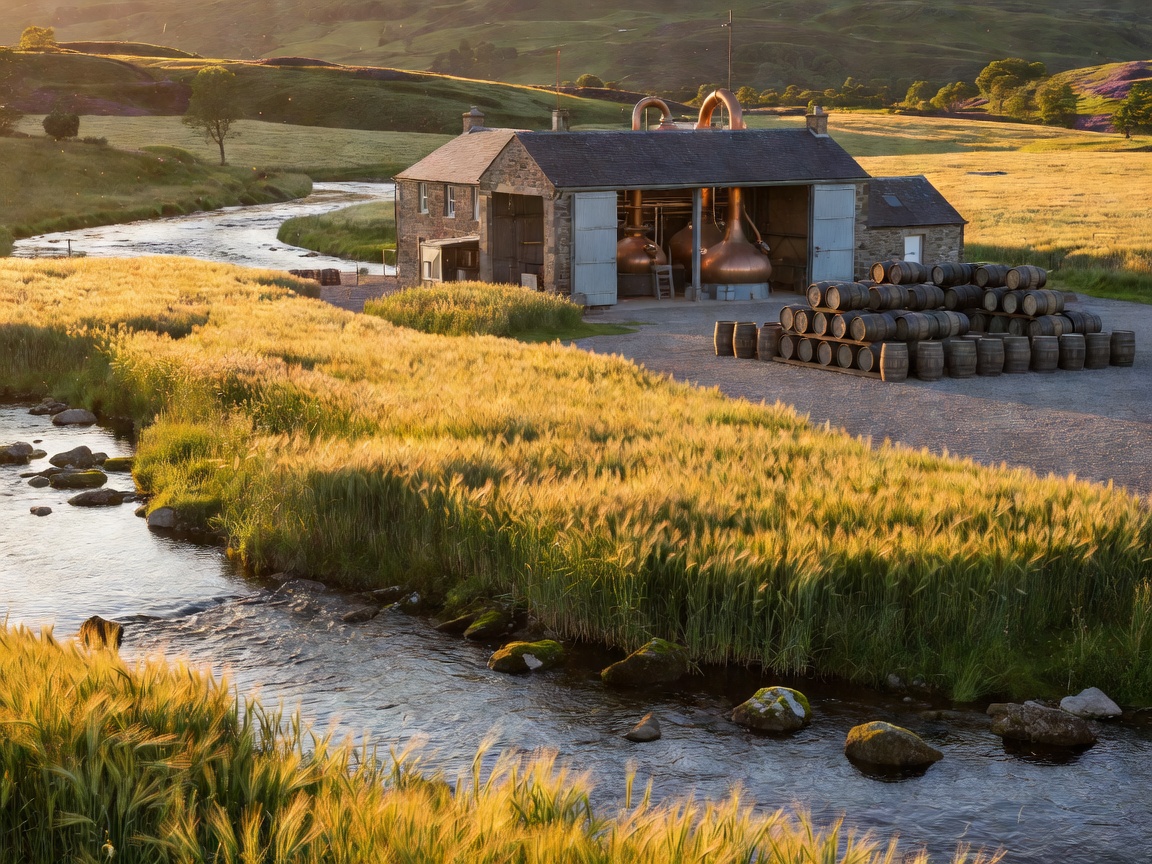
Why did Speyside become so densely populated with distilleries?
Water, agriculture, transport and nineteenth-century commercial growth all helped. Speyside lies within the wider Highland area but is recognised as a Scotch whisky region in its own right. Towns such as Dufftown, Rothes, Elgin and Keith became closely tied to malt whisky production, while the railway once made moving coal, barley and filled casks considerably less theatrical than hauling them over rough roads.
The region’s density encouraged shared infrastructure and access to skilled labour. It did not impose one production recipe. Glenfarclas, Glen Grant, The Glenlivet, Mortlach and Benromach all belong in a Speyside discussion, yet their spirit characters cannot be filed under one fruit-shaped heading. Some pursue light, highly refined distillate; others seek weight, sulphury complexity, wax, malt or smoke.
What creates Speyside’s range before the cask intervenes?
Malted barley is milled, mashed and fermented before batch distillation in copper pot stills, as required for single malt Scotch whisky. Variation begins inside that apparently standard sequence. Clear wort can support a cleaner, fruit-forward fermentation, while cloudier wort carries more grain material and may contribute a heavier character. Fermentation time, yeast behaviour and washback material also alter the pool of flavour compounds reaching the still.
Still geometry matters. Tall stills and rising lyne arms tend to encourage reflux: heavier vapours condense and fall back, leaving lighter compounds to continue towards the condenser. Squatter stills or downward-sloping arms can admit a weightier distillate. That is a tendency, not a law. Heating rate, charge, condenser design and the points at which the distiller takes the middle cut can overturn a tidy diagram.
Mortlach provides the famous warning against regional shorthand. Its complex partial triple-distillation arrangement produces a notably weighty spirit. Glen Grant, by contrast, is associated with purifiers that increase reflux. Both are Speyside. The postcode has done its best; the equipment has declined to co-operate.
Does “Speyside style” really mean sherry casks?
No, although sherry-seasoned oak has a conspicuous role in the region’s identity. European or American oak casks seasoned with oloroso or other sherry styles can add dried fruit, spice, nuttiness, tannin and colour. Ex-bourbon barrels commonly bring vanilla, coconut, citrus and honeyed notes while allowing distillery character to remain easier to spot. Refill casks contribute more slowly and may be chosen when the spirit, rather than fresh oak influence, is meant to lead.
Cask size, oak species, previous contents, seasoning quality, fill strength, warehouse conditions and maturation time all matter. “Sherry cask” is therefore the start of a useful question, not its answer. A full maturation and a short finish are different propositions. So are first-fill and refill wood. Labels may disclose these distinctions, but producers are not obliged to print a complete cask biography.
How should a Speyside label be read?
- Single malt
- Produced from malted barley at one distillery, using pot stills. It may combine many casks and vintages.
- Age statement
- The age of the youngest whisky in the bottle. Older components may be present without receiving a parade.
- Natural colour
- A voluntary statement indicating that plain caramel colouring has not been used to adjust appearance.
- Non-chill-filtered
- A voluntary process statement. Haze may appear when whisky is cool or diluted; it is not a quality defect.
- Cask strength
- Usually indicates bottling without substantial reduction to a standard strength, though wording and batch strength vary.
Also check the named bottler. An independent bottling can present spirit from a familiar distillery at an unusual age, strength or cask specification. That can reveal another side of the make, though it does not automatically outrank the distillery’s own bottling.
How does Speyside compare with the other regions?
Against Islay, Speyside is less routinely associated with heavily peated malt, but peated Speyside exists. Against the Lowlands, it is commonly imagined as richer, yet both regions contain light and weighty examples. The Highlands surround it geographically and overlap stylistically. Campbeltown is far smaller and often associated with oil, brine and robust texture, though those descriptors remain producer-dependent.
Choose by production evidence. For a clearer view of distillery fruit, look towards ex-bourbon or refill maturation. For stronger oak-led dried-fruit character, seek explicit sherry-seasoned cask details. For texture, note bottling strength and filtration statements. Region first, specifications second, glass last. The last item has an inconvenient habit of settling the argument.