Can “Highland style” mean anything precise?
Only at a broad level. The legal Highland region extends across a large and varied part of Scotland outside areas separately defined as Speyside, Lowland, Islay and Campbeltown. It includes mainland coastal sites, inland distilleries and the islands other than Islay. The result is less a flavour family than a large administrative drawer containing many respectable but unrelated socks.
Clynelish is often associated with waxy texture and coastal notes. Glenmorangie is known for a comparatively light, fragrant new make shaped by tall stills. Dalmore commonly appears in discussions of richer maturation and sherry influence. Oban often balances fruit, malt and restrained smoke. Ardnamurchan and Nc’nean illustrate differing modern approaches to raw materials, energy and spirit style. Geography places them together; equipment and cask policy pull them apart.
Which production decisions explain the differences?
Start with the barley and malt specification. Most Highland single malt is unpeated, but peat is neither forbidden nor absent. The grind affects how husk, grits and flour behave in the mash tun. Water extraction and wort clarity influence the liquid sent to fermentation. Long, controlled fermentations may favour fruity esters, while shorter regimes can retain more cereal and weight, although yeast, temperature and washback conditions complicate that comparison.
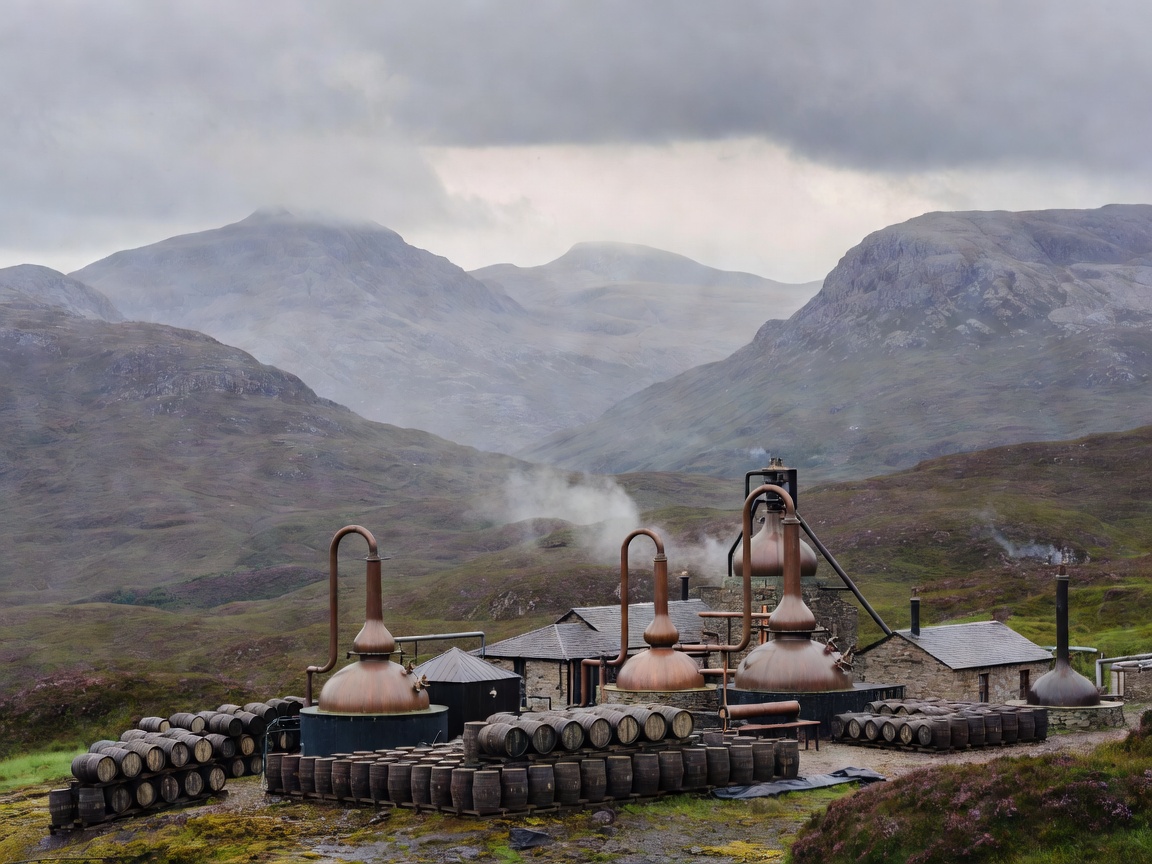
Pot-still shape is conspicuous and often overworked as an explanation. Tall necks, boil balls, lyne-arm angles and purifiers affect reflux and copper contact. Heating regime and spirit-cut timing are equally important but harder to photograph. Worm-tub condensers provide relatively limited copper contact and can support heavier, sulphury or meaty characteristics. Shell-and-tube condensers generally offer more copper interaction and a cleaner result.
Some Highland makes rely on texture as much as aroma. Clynelish’s waxiness, for example, has long prompted discussion of fermentation and distillation conditions rather than a magic local ingredient. Describing texture requires attention to bottling strength, filtration and dilution too. A whisky presented at a higher strength may feel fuller, though alcohol itself can also obscure detail until water is added.
How do cask and warehouse choices work across such a large region?
There is no uniform Highland cask policy. Ex-bourbon barrels can emphasise vanilla, orchard fruit, citrus and distillate character. Sherry-seasoned oak may add dried fruit, spice, chocolate, nuttiness and tannin. Refill wood offers gentler extraction. Wine, rum and fortified-wine finishes extend the palette but can make it harder to identify the underlying spirit when the secondary cask dominates.
Warehouse type affects temperature movement and airflow. Traditional dunnage warehouses place relatively few cask layers over an earthen or solid floor; racked warehouses store casks in larger structures. Position within any warehouse creates variation, which is one reason casks from the same filling run can diverge. Coastal language may describe genuine sensory impressions, but the mechanism should not be reduced to sea spray wandering through oak on a mission.
Are northern, western and island styles official divisions?
No. Writers and retailers commonly use informal labels such as Northern Highlands, Eastern Highlands, Western Highlands and Islands because the official region is unwieldy. These labels can help organise a shelf, but they are not protected Scotch whisky regions in the same manner. “Island” is especially useful geographically and especially unreliable stylistically.
Talisker from Skye is associated with pepper and smoke. Highland Park from Orkney often combines aromatic peat with sherry-cask influence. Arran produces largely unpeated, fruit-led malt while Lagg, on the same island, focuses on peated spirit. Jura has its own changing balance of unpeated and peated styles. An island category therefore contains several contradictions and a ferry timetable.
How should a Highland bottle be assessed?
Read the legal category first. “Highland single malt Scotch whisky” identifies malt whisky from one Highland distillery, not a uniform style. Then inspect the age statement, alcoholic strength, cask description and process declarations. If “double cask” or “triple cask” appears, look for detail about the actual wood and previous contents; counting cask categories does not reveal their proportions or influence.
For lighter spirit-led character, tall-still distillates in ex-bourbon or refill wood are a reasonable direction. For greater weight, investigate worm-tub condensation, robust cut policies and richer casks. For smoke, identify whether peat is central or supporting. Compare named production choices rather than relying on compass points. North is excellent for navigation. It is less accomplished at specifying ester profiles.